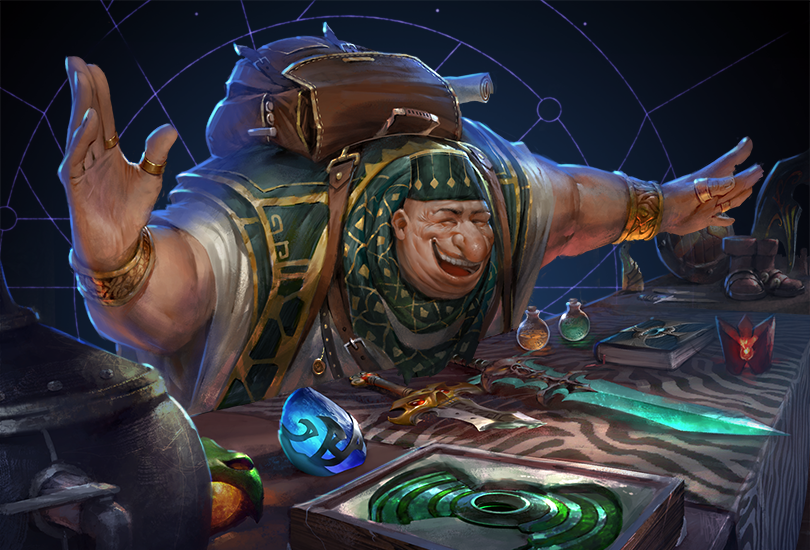
https://www.youtube.com/watch?v=8-ep1QnXLQ8
I enjoyed helping design the shop in Artifact and I think it provides a lot to the game. We knew we wanted the heroes to get more powerful over the course of play – and in fact we experimented with some experience and leveling systems to accomplish that. We quickly came to the conclusion we could get a lot of the feeling of improvement from a shop which sold items that upgraded the heroes. Rather than collect experience, players would collect gold. The gold could be spent to flexibly upgrade your heroes in different ways during the course of the game.
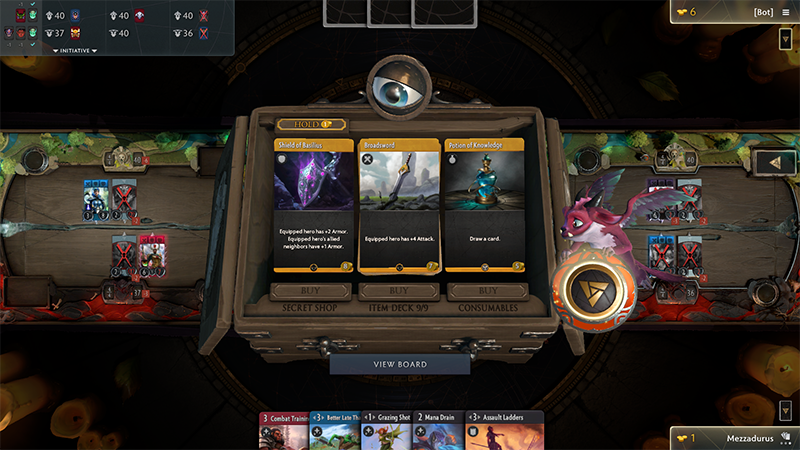
The shop is composed of three panels, the rightmost selling a random consumable item. These items are effects that we wanted players to always have access to, we didn’t want them to be forced to put, for example, healing potions in their deck.
The middle panel is dedicated to equipment the player chooses to bring into the game. It is a minimum of 9 cards, and unlike the other two panels, when you purchase something from the center panel a new option is immediately revealed. This means that when you have multiple purchases buying from the center first is correct so you can see the new revealed option before committing to further purchases.
The leftmost panel is the most exciting panel – the Secret Shop, which has who-knows-what for sale. While I wanted to see players build their shop deck with equipment that made sense for their strategy – we wanted to have the possibility that anything might be available in the shop, that it was bigger than just your deck list. This is the sort of mechanic that is easy to do digitally, but hard to do with a physical product.
The additional choices had to occasionally be better than what a player has in their deck, or they will rarely find themselves buying from the secret shop – and its’ cool appeal would be at best a surface appeal. This might happen, for example that a player has much more gold than they usually do, and so their equipment deck list might not have some bigger pieces they could afford. Also, it gives an extra chance to get what a player needs in a pinch – you might really need a weapon and you don’t get the opportunity from your deck list – you might have one that can work from the secret shop.
Because of the secret shop, one type of equipment whose design I began really valuing was equipment that would be conditionally valuable – perhaps conditional enough that it wasn’t correct to put it in my equipment deck, but when the conditions arise it makes the offer at the secret shop an unexpected boon. An example of such a piece of equipment is the Demagicking Maul, which can destroy an opponent’s lane improvement. This is the sort of equipment I might not make room for in my deck – but can be really happy to see when playing particular decks, or when one of my opponent’s improvements is really just begging to be destroyed.
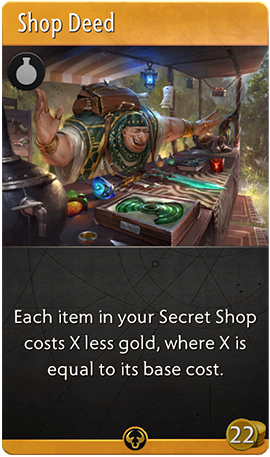
One of my favorite cards from the shop is the Shop Deed. It reduces all costs from the secret shop by the cost of the item, in other words – you can get whatever the secret shop is offering for free. The wording on that is a bit peculiar though, why doesn’t it just say the items are free? That stems from our desire to make as much as we could modular and unbounded. If a Shop Deed merely made items free – then what would a second Shop Deed do? The way we made it, a second shop deed actually reduces the cost to negative numbers, and just as we respect negative numbers for armor – we respect negative numbers for item costs. You can start making a lot of money from your second shop deed!
- Richard Garfield