What's happening / TLDR: Developer diaries introduce details of Espiocracy - Cold War strategy game in which you play as an intelligence agency. You can catch up with the most important dev diary (The Vision) and find out more on Steam page.
---
Who is the player in a game? Who you are?
(Linguistic disclaimer: this dev diary usually replaces "player" with "you". Apologies to readers who detest "you" form)
Video games of old didn't ask this question. You're firing at asteroids, who cares. Then, as games became deeper, a slice of this depth came from trying to think who is the player - with the exception of many strategy games. In most of them, you're a god, a spirit, a Rube Goldberg machine, just play the game.
Espiocracy, as stated in the very first diary, completely rejects vague-player approach typical for strategy games. The game is rooted in finding, defining, and constantly using the answer to "who is the player". Playing not "as nebulous France" and instead "as defined organization(s) in France" is the secret sauce to making the best possible game out of the Cold War (and beyond), in my opinion, backed first by a few prototypes and now by three years of development.
However, it may be more profound than just nailing the setting. Across many forms of art and entertainment, you can observe historical progress from ">you< doesn't matter" to "actually >you< is very important". Whether it's the development of perspective in painting or the evolution of narration in literature, asking "who are you" and thinking deeply about answers (even if there is no good answer) enriches not only the piece but sometimes even the entire form of human expression.
This dev diary will continue our journey through the alleys of "Who Is The Player" town. Its topic has been chosen in a poll by people who want to read even more about it on top of three full diaries ([1], [2], [3], and many more partially touching it). Perhaps it's not a mere interest in the main idea behind the game but more of a testament to the yearning for answers, new angles, and wider progress of this form of entertainment.
Intelligence Community
Much like other grand strategy games, you begin a new campaign in Espiocracy by choosing your nation.
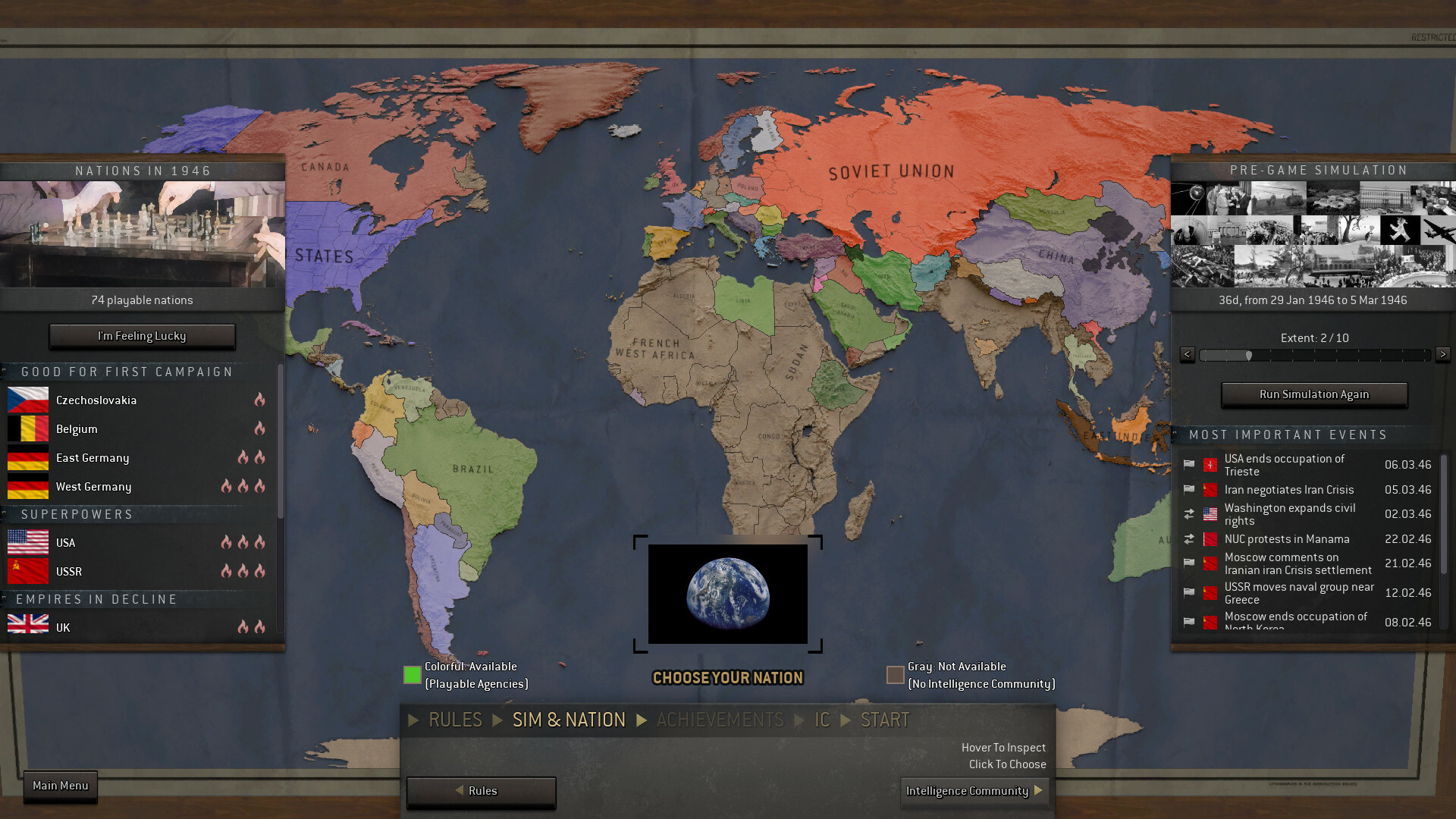
You are inherently tied to a nation - and most interesting areas of the game, such as nuclear brinkmanship, rely on the power of a state - but you're not a nation.
To be technically precise, you are playing as an intelligence community. You can customize it just after choosing the nation.
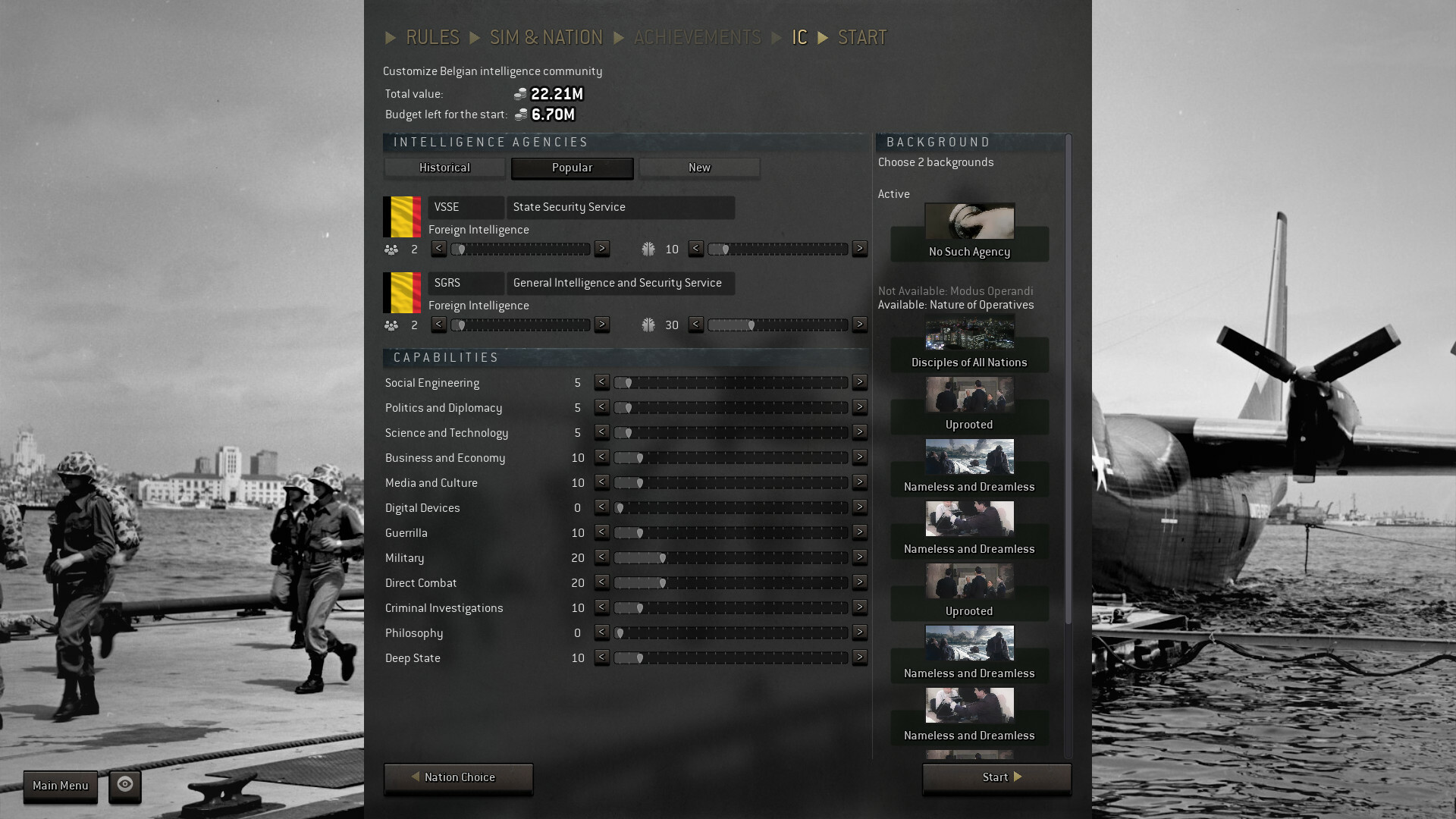
(Similar screenshot appeared in previous agency-related diaries, it's posted in current form here for clarity.)
"Intelligence community" encompasses all organizations and individuals tasked with espionage. Out of practical logic and pure necessity (eg. current American intelligence consists of 18 organizations!), the game joins and abstracts away many of them to form two layers of player persona: community-wide (this section) and agency-wide (next section).
On the level of the entire intelligence community, you command budget (more details in later section), important parameters (such as trust and need), and wide forms of progression (primarily capabilities and intelligence programs).
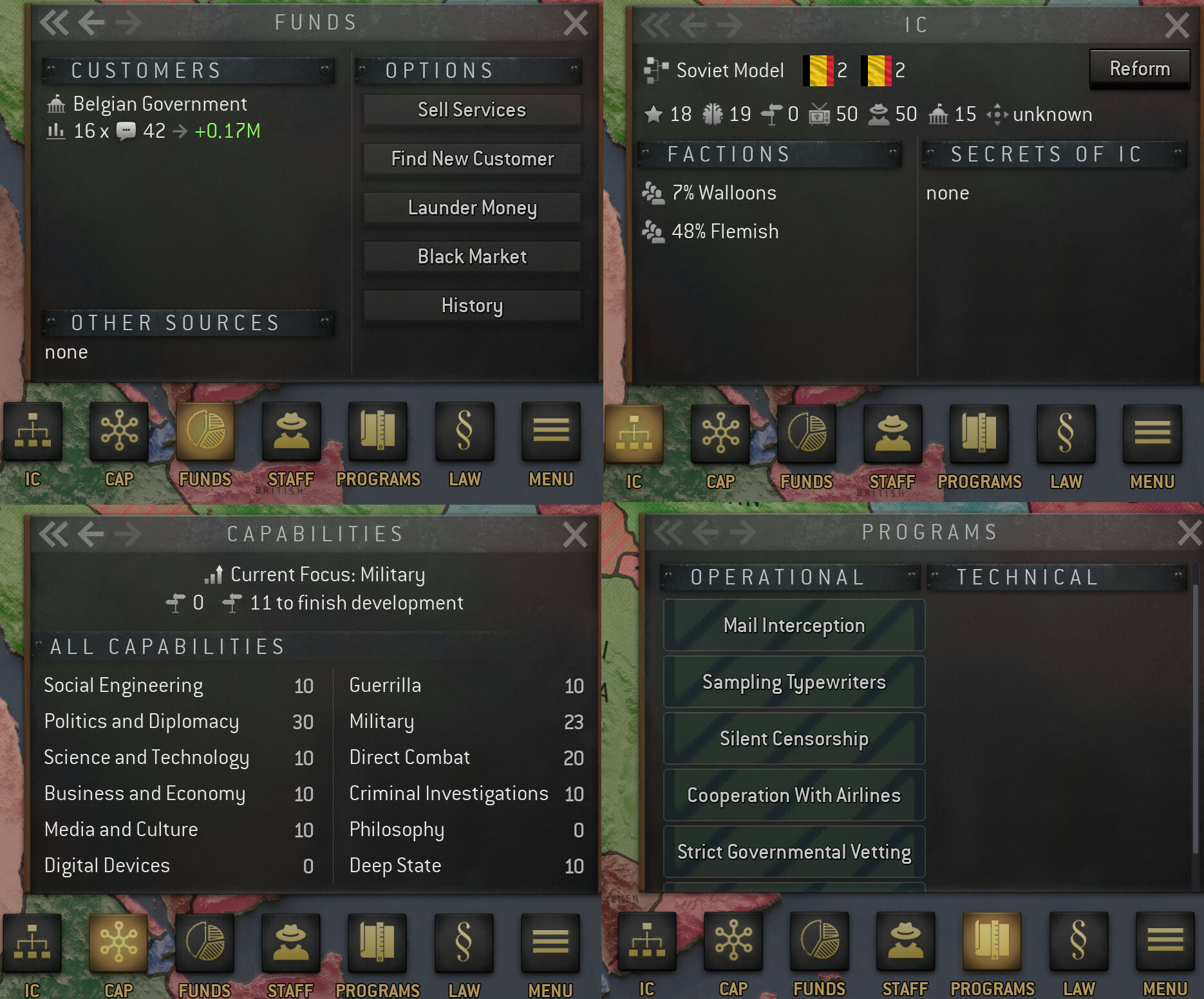
Actors
In terms of actual objects in the game world...
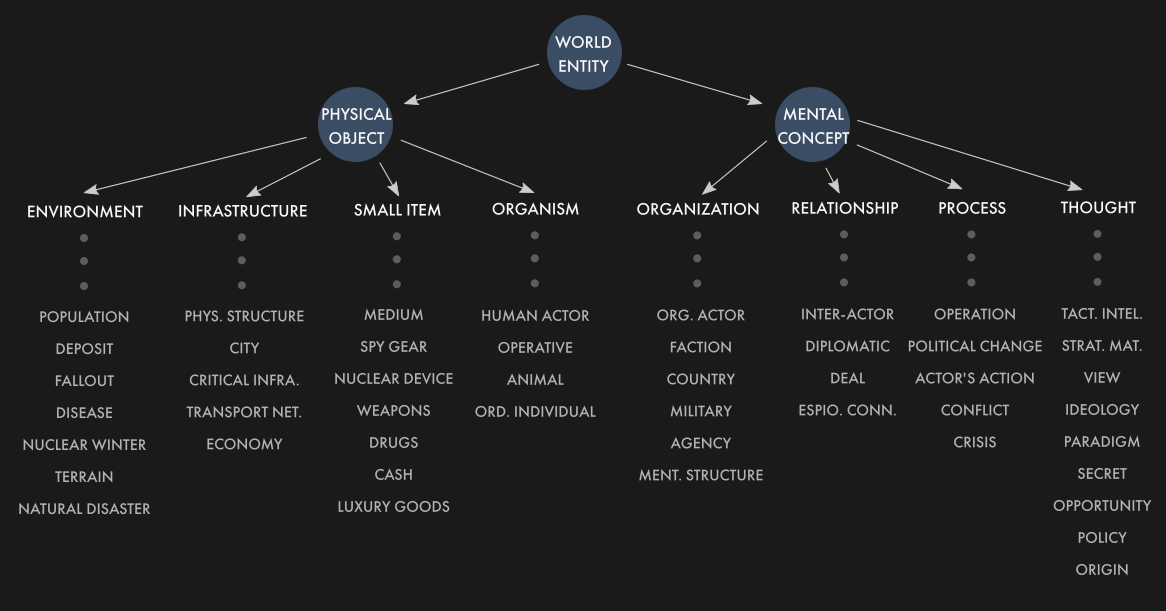
...an intelligence community is just a "mental concept" - an idea, incapable of acting in the world (!). It has to be embodied by active entities on the ground: intelligence agencies, implemented as actors, existing between other actors in the game.
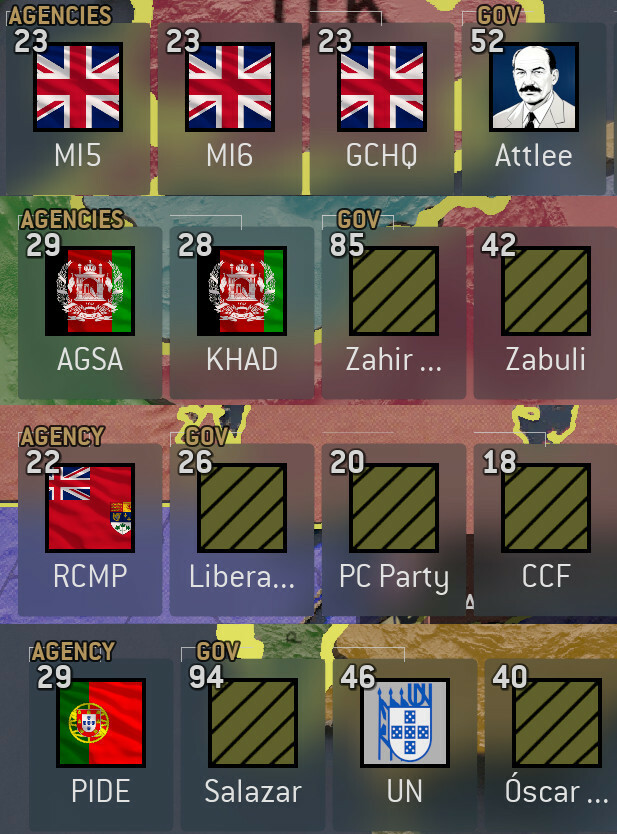
All your actions are carried out by a particular agency and often by a specific section inside such agency.
(Lack of player-controlled agencies means that no actions are possible! This nominally leads to a game over screen. However, all game-over conditions can be turned off, and in this case player spends a short period actor-less, and therefore without ability to act, until new actor(s) are established by the government.)
For many playable nations, both "you play as an intelligence community" and "you play as an intelligence agency" are true - when the community consists of a single agency. This is usually the case for two extremes, either very small communities (such as a department in police forces) or very large communities (usually monolith ministry).
In many other cases, you control up to 3 actor-agencies. If you recall old DD#8, the game at the time had community-wide models - that is no longer the case and now it's flexibly agency-based. An agency is defined by:
- Responsibilities. Any of these in any agency: domestic / foreign / civilian / military / signals intelligence. Among many influences (more on that below), most importantly it affects operations as battles. Attacking vs defending sides are not defined by communities (not American vs Soviet player) but by agencies. If you, as an American player, target the Soviet government, it will be CIA vs KGB operation, but if you target Soviet military installations, it will be CIA vs GRU - and in the late game, if you try to hack Russian networks, it may be NSA vs GRU (if Russian player made GRU responsible for signals).
- Organizational form. An agency can be: independent / ministry / military / police / foreign / religious / secret organization. Every form differs in costs, incentives, legal boundaries, and possible actions (details evolve during playtesting). Their availability is defined externally and may be a goal in itself, for instance players in occupied countries usually start with pretty limited "foreign" organizations (eg. Arisue Unit in Japan 1946), try to advance independence of the country and progress to more influential & independent forms (eg. PSIA in Japan 1952, a ministry organization in terms of game mechanics). On the other end of the spectrum, after a significant loss of trust and need your community may be forced to be reformed, and resulting agencies may have a less optimal form (eg. in Austria, after independent BVT failed to prevent the terrorist attack in 2020, it was replaced by a ministerial DSN).
The choice between one or more intelligence agencies is a strategic decision, a'la building wide or tall: spreading or stacking responsibilities, diversifying forms or focusing strongly on one organizational form, higher peaks or a higher average of certain traits. In addition, since agencies are full actors in the game world, the number of agencies significantly affects direct player-vs-player operations. 3 agencies mean 3x different targets - on one hand, more targets for the attacker, and more places to defend for the defender; on the other hand, a breach in one agency usually does not spill over to other agencies, and the attacker has to expend more resources to attack more than one agency. If the second hand is more appealing, it's no coincidence. As mentioned above, both in the real world and in the game, a single agency is either very small or very large, with everyone in the middle preferring multiple agencies.
Example: Two Germanies
For any new intelligence community in the game, you can use "Historical" or "Popular" preset:
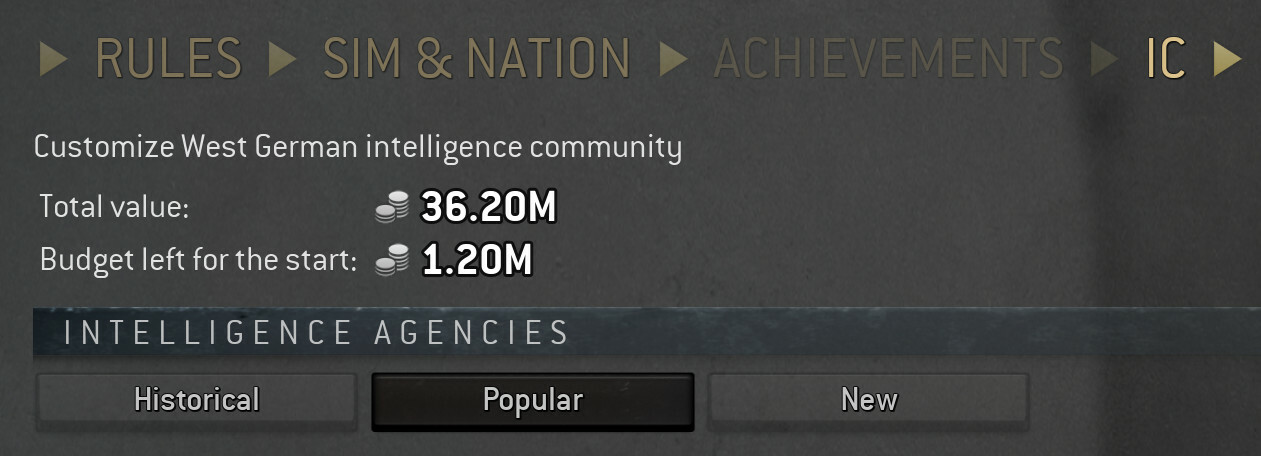
"Historical" proposes historically accurate community and agencies as of March 1946, while "Popular" gives you well-known agencies of the Cold War. Both options have their place beyond simple personal preference - in some countries, historical agencies were very interesting in 1946 (such as Arisue Unit in Japan), while in other countries they were more confusing and less exciting (eg. historically, in 1946 instead of CIA vs KGB there was CIG vs MGB). Beyond simple numbers, these two also define many other initial conditions. Both sides of the Elbe River provide a good example of differences between playable intelligence communities (IC):
- West Germany, Historical IC: Gehlen Org. A small unit of (mostly) Nazi veterans funded by the USA. High experience, tradecraft, capabilities in areas such as military, access to already existing intelligence structures - but also initial low trust, reliance on another country, many internal secrets, and low morale.
- West Germany, Popular IC: BFV and BND. Respectively, independent domestic and foreign intelligence agencies. Larger, with a government-supported budget, partially cleaner slate, lower various skill-adjacent parameters, and much higher vulnerability to eastern infiltration attempts.
- East Germany, Historical IC: Volkspolizei. Intelligence section in police forces. Mostly controlled and financed by the USSR. Many sections with low skills and almost no ability to conduct espionage abroad.
- East Germany, Popular IC: Stasi and HVA. Two ministry organizations (in the real world HVA was under Stasi but the game currently separates them to better simulate their historical activity), respectively domestic and foreign responsibilities. The former with many averagely skilled sections and almost unlimited legal powers, and the latter highly skilled. Both deeply infiltrated but no longer funded by MGB/KGB.
Deeper Funding
Speaking of financial gameplay, let's take a quick look at its current iteration at the end of the dev diary.
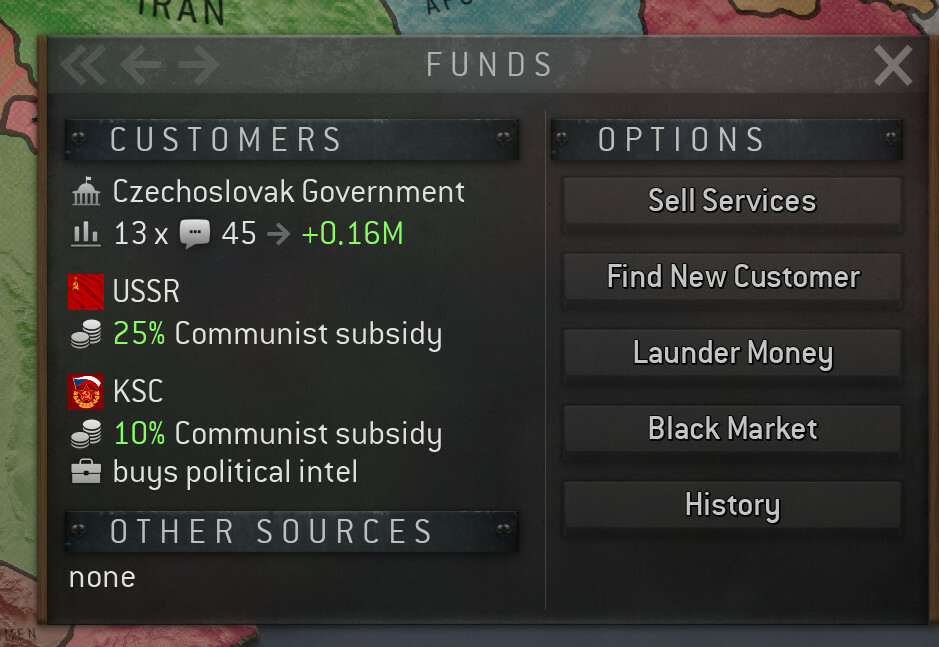
Multiple contributors described in DD#32 were proved to subtract more than add to the game. Instead, now the player can:
- Receive monthly and yearly transfers from the government based on State Power Index x trust and need (if the community is funded by the government)
- Find customers (intelligence term), governmental or otherwise, who subsidize certain activities and buy intelligence
- Develop less-official sources of income, anywhere from extortion (a story as old as any intelligence agency, especially in autocratic countries) to middleman cut (eg. CIA received 5% of the Marshall Plan funds)
These feed into three main accounts:

From left to right (first value is the number of available sections): official (spent on anything roughly legal), transferable (can be moved to another entity, usually used to fund various actors), and illicit (spending without oversight, not available for official expenses such as hiring).
Behind The Scenes
► Some strategy games introduce obvious and very intuitive embodiment of the player as a single individual - a leader, a manager, a king, a director - in the game world. There is no director in Espiocracy. The idea was considered seriously and even partially prototyped but it failed (as I like to say, it subtracted more than added). In small part, this can be attributed to the ephemerality of a director of the entire intelligence community - many countries don't have one, and those which do, usually assign very limited powers to such a person. In larger part, implementing a director (even of an intelligence agency instead of a community) anywhere near the real world (as is the ambition of the game in all mechanics) is surprisingly mundane, administrative, and political. For instance, George Bush senior was the director of CIA, in between working in a US-Chinese office and in a Houston bank... And in the largest part, it failed because it can be implemented only in two equally bad ways. Either as a very weak flavor/vanity player persona (and then we're just wasting an opportunity to associate the player with something strong in the game world) or as an illogically influential player persona in the world of Cold War intelligence agencies (and then we're lowering immersion, which is the opposite of what we primarily aim for with good player embodiment). There is a middle ground for some places for some time (eg. Markus Wolf) but it's too finicky / local / short-lived to meaningfully chase in this game.
► This diary does not mention domestic conflicts between agencies (eg. CIA vs FBI) because they do not exist in the game. While it is a frequently requested feature, I see it as a slippery slope into a bureaucracy simulator - and a world map would be pretty bad interface for bickering between Langley and Washington, they are just a few pixels apart! On a more serious note, it is one of the few rare cases where implementing realism / historical accuracy is in conflict with the player as an intelligence community. If you control both CIA and FBI, a turf war between them is just an exercise in anti-player frustration. There's only a tiny single "red tape parameter", with very limited influence on the game (higher value primarily leads to slightly longer actions, eg. it takes more time to establish an intelligence station) - which I introduced on purpose to avoid implementing domestic inter-agency conflicts and instead distill any such cravings into a little silly number.
► "Customers (...) who (...) buy intelligence" - yes, it's a new thing, intelligence mechanics at the heart of the game received new layers of depth and this will be probably the topic of the next dev diary.
Final Remarks
The next dev diary will be posted on June 7th!
---
If you're not already wishlisting Espiocracy, consider doing it
https://store.steampowered.com/app/1670650/Espiocracy/
There is also a small community around Espiocracy:

---
"This country wants no Gestapo, under any guise or for any reason" - Harry Truman in 1946