Terraforming Preview | Adding More Materials to Universe Sandbox
Universe Sandbox · published

The Moon is bombarded with asteroids made of carbon dioxide, sulfur dioxide, methane, and water. These materials are transferred to the Moon's surface, forming lakes that flow together and eventually evaporate to create an atmosphere.
Our new composition system, including eight new materials, like oxygen and methane, is still in active development and has not been released, but you can opt-in to a preview version now on Steam. Every planet in Universe Sandbox is simulated with a combination of materials, like iron and water, that are used to compute properties like planet radius and water flow. However, our current composition system is too simple to simulate phenomena like lakes of liquid methane on Saturn’s moon Titan. Our new system will allow you to realistically simulate planet surfaces and atmospheres, accurately terraform planets, and more.
Try the Terraforming | Update 34 preview right now!
Eight new materials and our new composition system are now available for testing and feedback. Learn how to opt-in to a preview version on Steam:
https://universesandbox.com/support/previewversion
Material Properties in Universe Sandbox
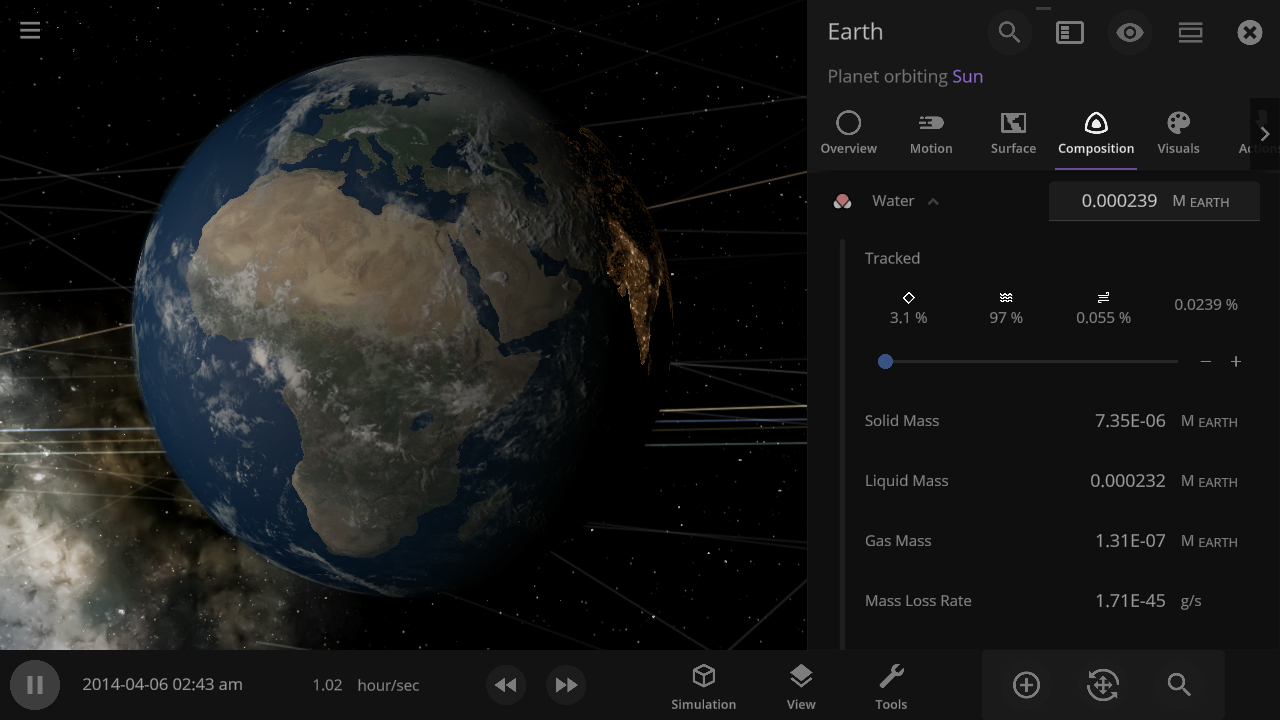
The Composition tab shows material properties, including total mass, the percentage and mass in each phase (solid, liquid, and gas), and more. This feature and interface are a work in progress.
Current Composition System
Universe Sandbox’s current composition system uses four materials (iron, silicate, water, and hydrogen) each with a set of physical properties including
- Density - to compute an object’s mass and radius and determine where materials are within a planet (for example, iron is the densest so it's at the core).
- Thermal capacity - energy required to increase the material’s temperature by one degree. Used to determine the Surface Heat Capacity of a planet.
- Molecular weight - average mass of a molecule of the material. Used to create clouds of evaporating gas called volatiles.
Water, the only material currently simulated across an object’s surface, has some additional properties
- Boiling point - temperature where a material changes from a liquid to a gas
- Melting point - temperature where a material changes from a solid to a liquid
- Mass of the material in each phase (solid, liquid, or gas)
- Liquid and solid density, heat of fusion, and heat of vaporization - to determine how fast water flows, evaporates, and freezes on planet surfaces
- Realistic (and customizable) colors
New Composition System
Our new composition system has 12 materials: iron, silicate, water, hydrogen, helium, carbon dioxide, oxygen, sulfur dioxide, methane, nitrogen, argon, and ammonia. These are the materials necessary to simulate the most interesting internal, liquid, and atmospheric properties of most objects in our Solar System. Many, like oxygen and carbon dioxide, will also be necessary for life simulation.
Each material has all the properties described above, and they will update in real-time according to the conditions on the planet (though iron and silicate will only exist inside planets and won’t have customizable colors). Want to know the freezing point of carbon dioxide or see how fast it’s evaporating on your custom planet? We’ll simulate it in real time.
Using New Materials for Simulation
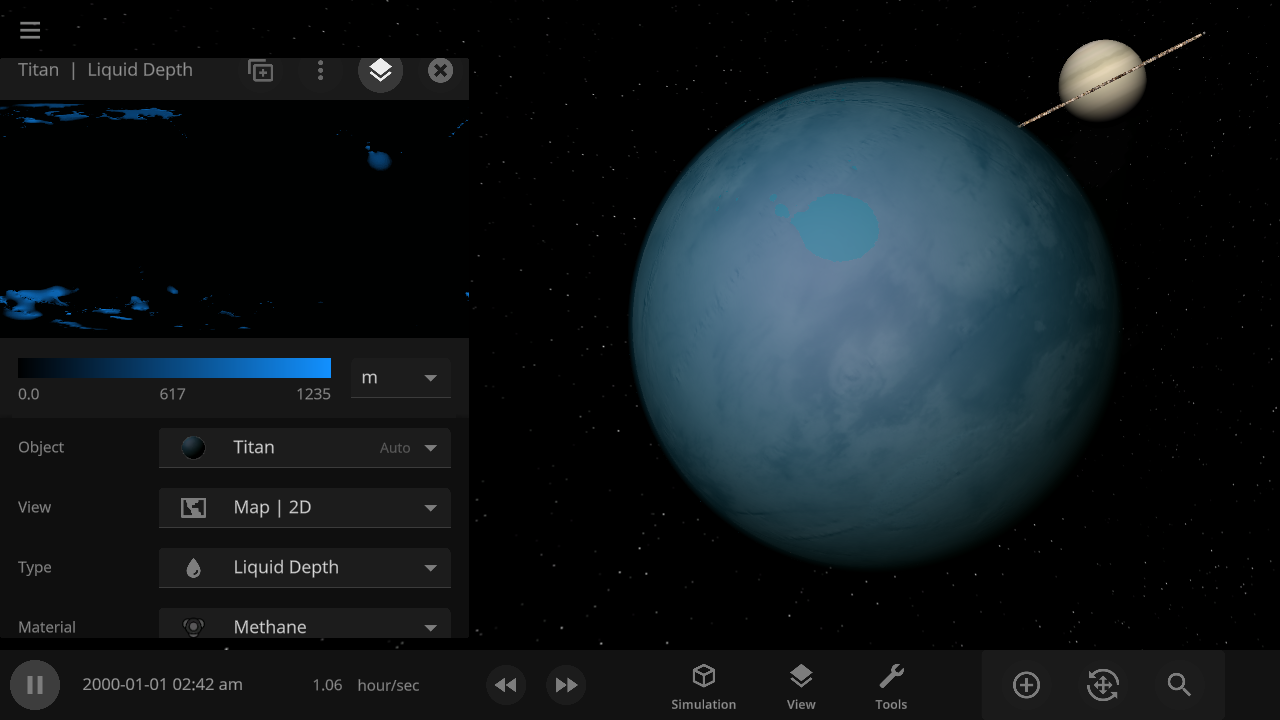
Titan with realistic lakes of liquid methane in turquoise at its poles. The Liquid Depth Data View shows the depth and location of the methane lakes.
Material Phases
In our new system, all new materials can exist inside of, on the surface of, or in the atmosphere of a planet. A material’s phase will be simulated based on its temperature and pressure using something called a phase diagram. Our phase diagrams, which show a material’s state at different temperatures and pressures, are based on data taken in labs as well as geological and astrophysical models of planets. Check out the real-life phase diagram of water from Wikipedia as an example, pictured below.
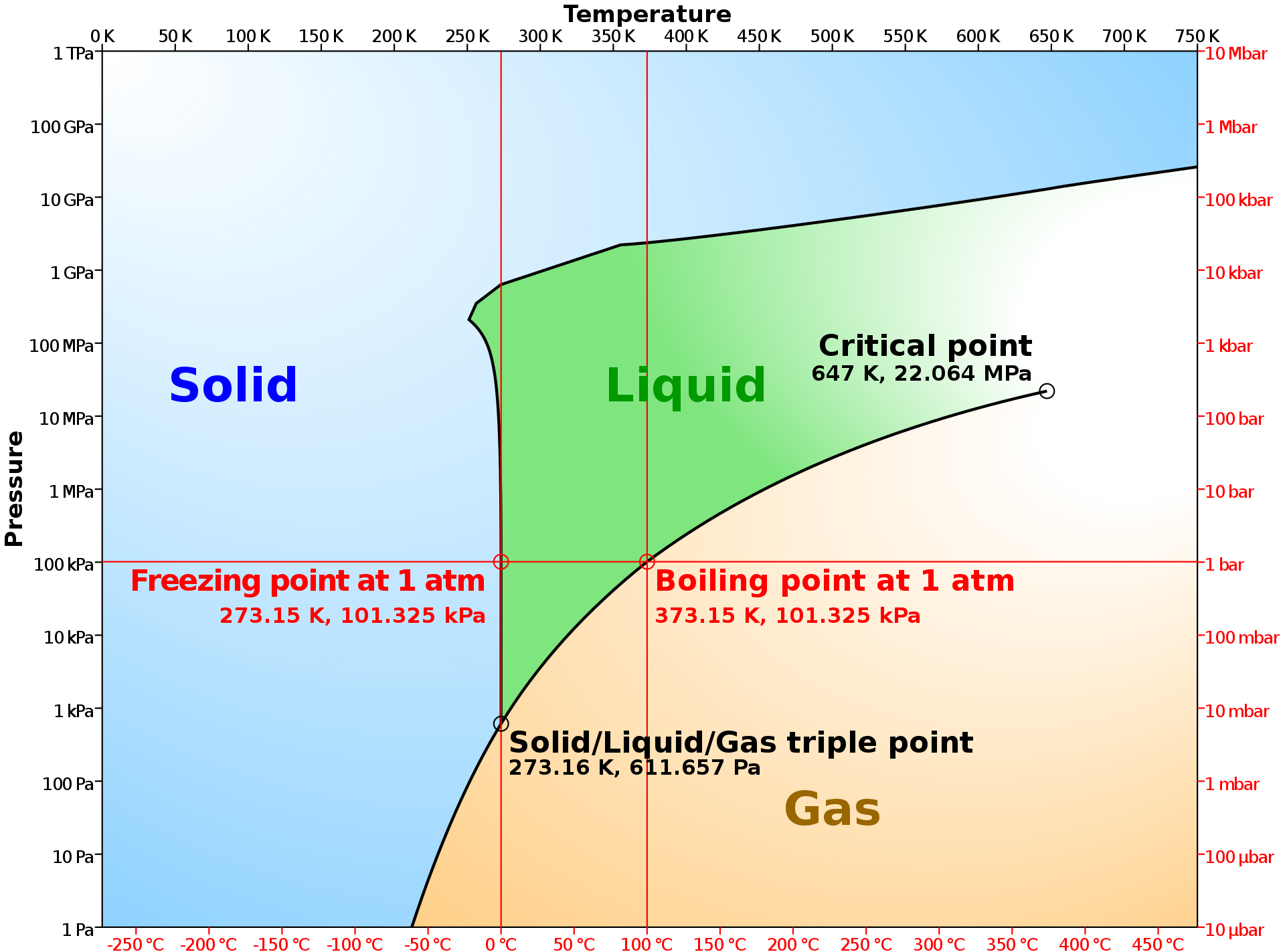
Phase diagram for water shows what phase water has at different temperatures and pressures. The Freezing and Boiling points are the temperatures at which water freezes and boils on Earth, and the triple point shows at what temperature and pressure water can exist as a solid, liquid, and gas at the same time. A supercritical fluid (which we have added to this diagram) has properties of both liquids and gases and is the phase state of atmospheres on gas giant planets. Source: Phase diagram. (2022, September 23). In Wikipedia. https://en.wikipedia.org/wiki/Phase_diagram
We plan to show the phase diagrams we’re using to simulate each material eventually, but right now, they’re primarily for testing. Our phase diagrams have been simplified for performance reasons but still closely reflect the scientific phase diagrams. You can compare our water phase diagram below, which has been edited for clarity, to the real-life phase diagram of water above.
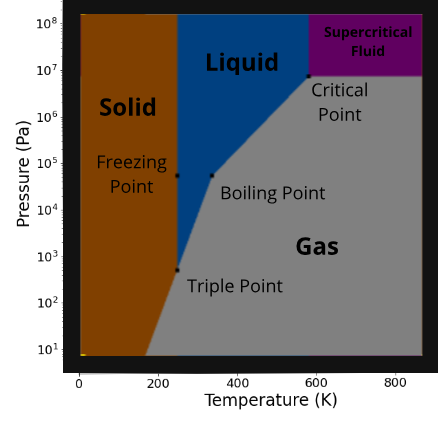
The phase diagram for water to be implemented in Universe Sandbox. This diagram has been simplified compared to the scientific phase diagram for water above for performance. It has also been edited for clarity.
Planet Interiors
The cores of planets are hot and under intense pressure. These extreme conditions affect a material's phase and density and thus the volume the material takes up in a planet’s interior. We’re using realistic models of planet density to compute and dynamically update planet radii from their compositions.
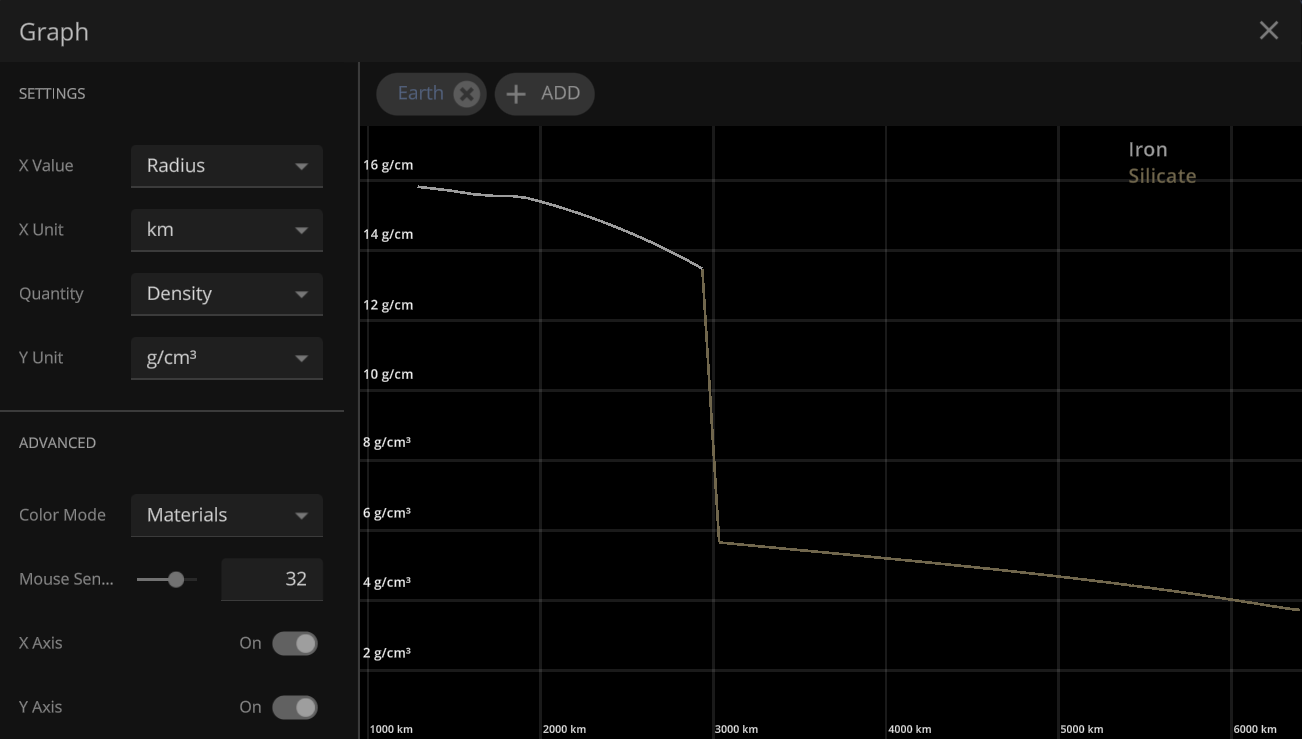
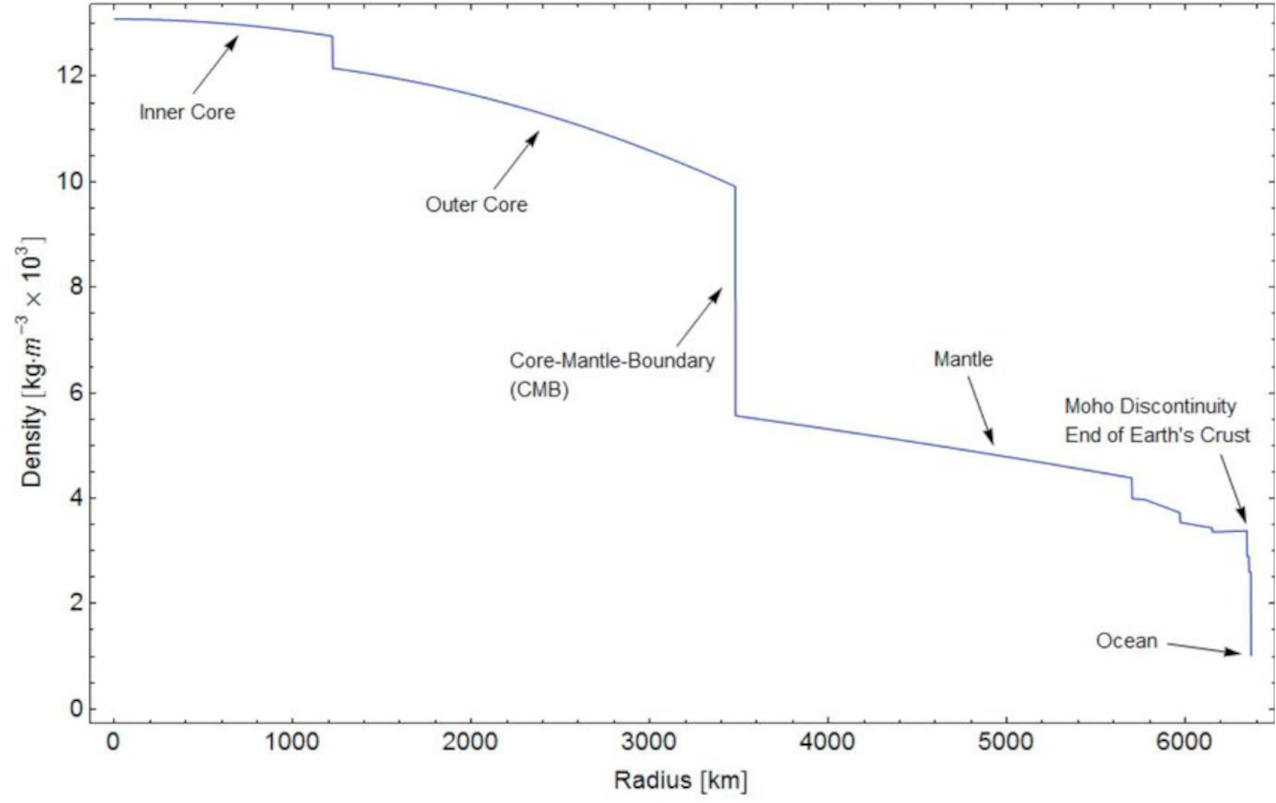
This graph shows the calculated density of Earth based on depth (or radius, 0 km being the core and 6,371 km the surface) in our in-game model (top) compared to a scientific model of Earth’s density (bottom; from A. M. Dziewonski, D. L. Anderson (1981). "Preliminary reference Earth model". Physics of the Earth and Planetary Interiors. 25 (4): 297–356. via Wikipedia). This feature and interface are a work in progress.
The graphs above show Earth’s density based on depth (or radius) in Universe Sandbox (top) compared to a scientifically researched model (bottom). While our in-game model is simplified, both graphs have the same shape and similar densities when compared to the radius. Comparing models allows us to check the integrity of our in-game model.
Our new composition model is more realistic but does not account for the porosity, or amount of tiny holes, of the internal structure of some objects, like the Moon. This means our model simulates some object radii slightly smaller than in real life. To account for this, we’ve added a porosity factor, which is usually an increase of a few percent, to adjust known object radii to match their real values.
The materials on the inside of planets, including iron and silicate (which are only simulated in planet interiors), do not mix together like materials on the surface or in atmospheres. Instead, we simulate planet interiors with layers of individual materials to accurately compute their radii.
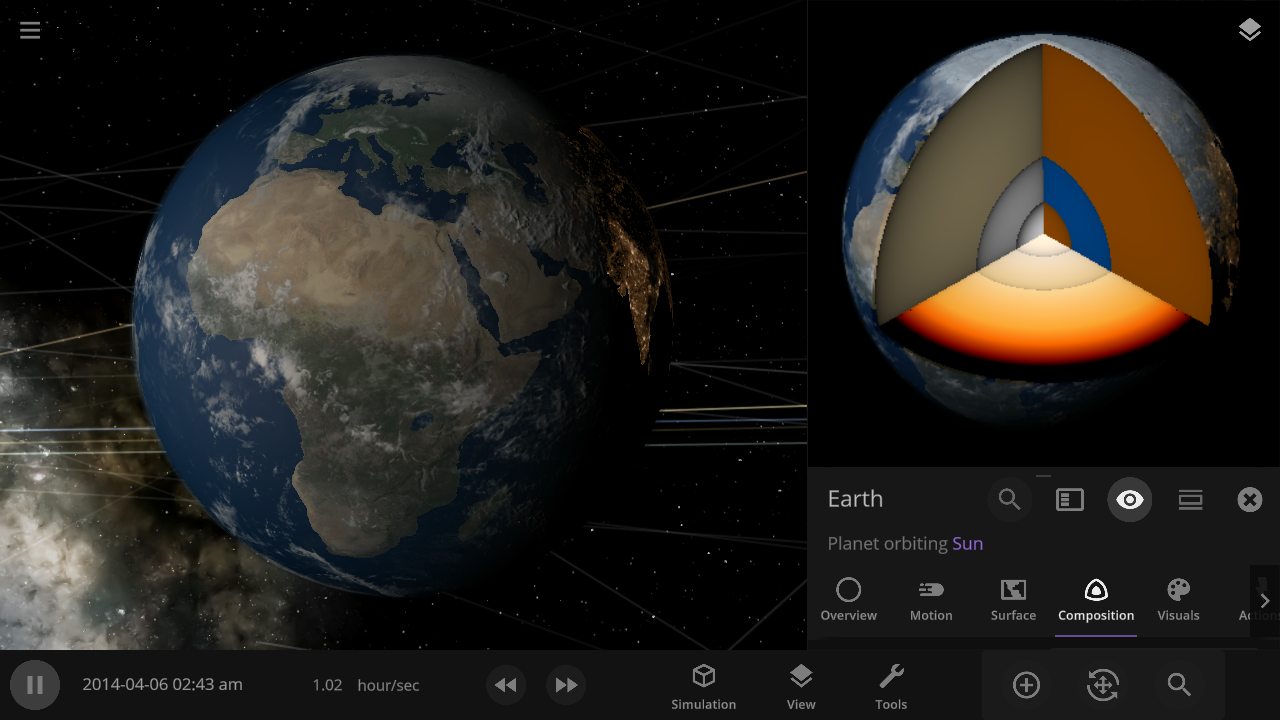
The cut-away view of Earth shows the individual materials (upper left), temperature (bottom), and phase (upper right) of each material from the inside out. We can see the model of Earth’s interior in Universe Sandbox has a very hot, solid iron core, a layer of molten liquid iron above it, and a layer of hot, solid silicate that cools as it gets closer to the crust.
Surfaces
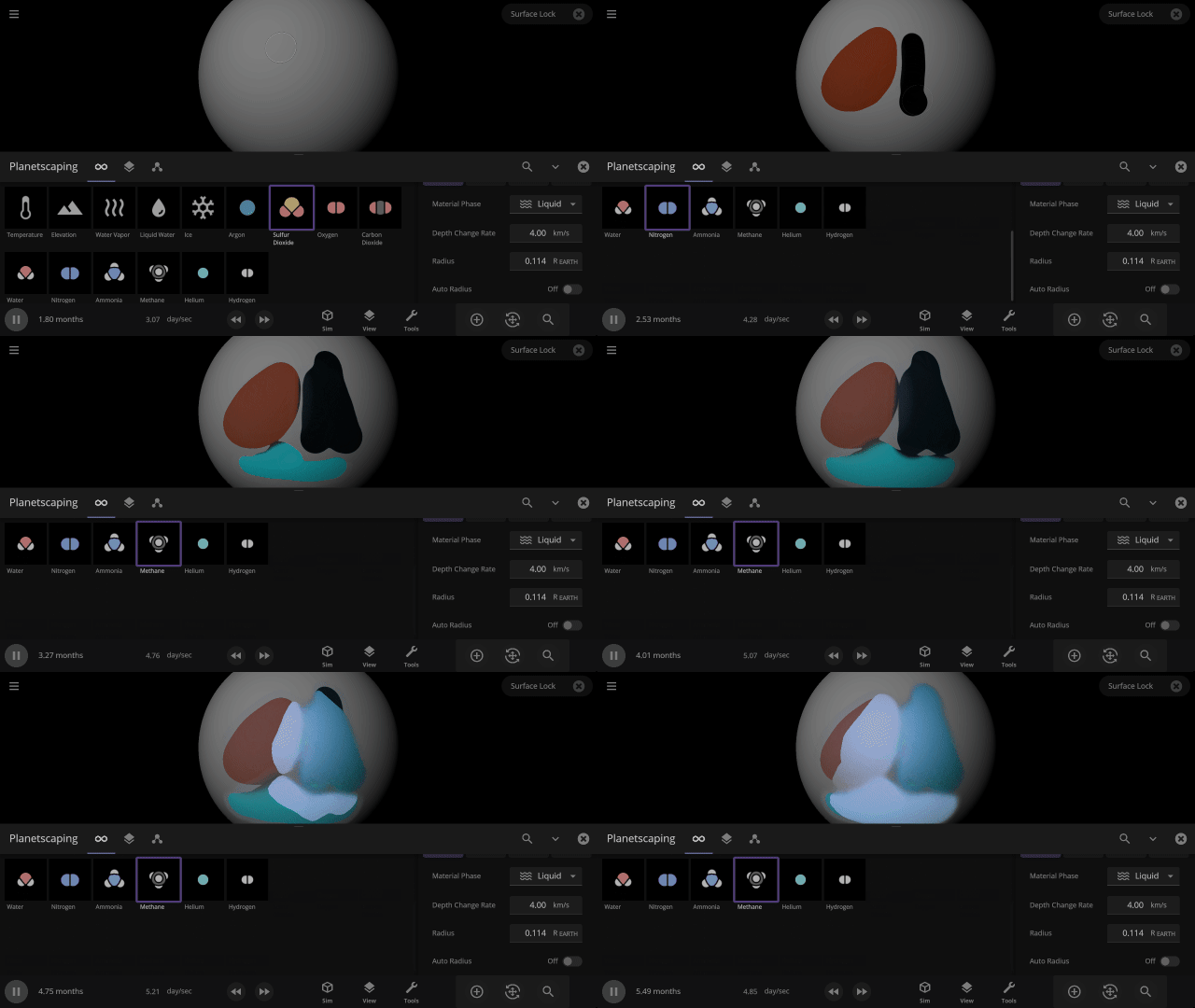
Planetscaping materials onto the surface of a blank planet while they flow together. As the simulation speed increases, the liquid methane, nitrogen, and sulfur dioxide start to evaporate, creating opaque atmospheres above their liquid surfaces. Planetscaping materials and the Planetscaping tool interface are works in progress.
Planets can be constructed with any (or all) of the materials available in Universe Sandbox using the Planetscaping tool, Material tool, or an object’s Composition tab. The four materials with the most mass are automatically simulated across an object's surface, similar to how water is simulated now. You’ll also be able to override this and choose which four materials to simulate across an object’s surface regardless of mass.
Surface materials freeze into ices, evaporate to become part of the atmosphere, and melt or condensate to flow together and form oceans. This allows us to realistically simulate phenomena like the lakes of liquid methane on Saturn’s moon Titan and plumes of gas evaporating into the atmosphere during collisions.

Ceres, a dwarf planet in the asteroid belt, collides with Earth. The surface heating on impact causes the ocean to boil, creating an opaque patch of atmosphere above the impact region. The small fragments colliding with Earth push the atmosphere upon entry, creating holes and dense shockwaves that create ripples in the atmosphere.
We plan to increase the number of simulated surface materials in the future, but we’re still determining the best way to do that without decreasing performance. For now, we’ve found that four materials allow for realistic simulation and fun experimentation without significantly affecting performance.
We simulate material colors on the surface and in the atmosphere based on their thickness and scientific measurements of how much light they absorb and emit. The colors of materials in each phase are also customizable across the simulation. For example, liquid water has the same base color on all planets (not including other color changes from the atmosphere or starlight).
Our material color simulation only simulates single material colors and doesn’t include any complex particles that might normally be suspended in them in real life. This means Venus and Titan may not look completely realistic yet because their atmosphere color comes from tiny amounts of complex materials not in Universe Sandbox. We are actively working on the best way to realistically simulate these colors.
Atmospheres

Planetscaping gaseous oxygen into Earth’s atmosphere creates an opaque area that expands outwards. Adding materials to planet atmospheres and the Planetscaping tool interface are works in progress.
Atmosphere color, opacity, amount of atmospheric heating (the greenhouse effect), and amount of Rayleigh scattering (which determines how light scatters in the atmosphere and is what makes Earth’s daytime sky appear blue) on planets is realistically simulated from the mixture of gasses in a planet’s atmosphere.
You can create realistic Earth-like atmospheres for habitable planets and oppressive Venus-like atmospheres just based on their compositions. Currently in Universe Sandbox, this is only possible by manually changing a planet’s Infrared Emissivity, which can increase the amount of heat the atmosphere of a planet retains.
The color and opacity are simulated locally throughout a planet's atmosphere. If you add lots of oxygen in a single region of a planet’s atmosphere, it will get more opaque and change color based on the amount of oxygen in just that area.
New Minimum Operating System Requirements
To add new materials and eventually simulate more than four materials across planet surfaces, we will be dropping support for Windows 7 when this feature is released.
While it is never fun to have support dropped, this will affect just 0.25% of our users and will allow us to leverage newer computational methods to increase the performance of our surface simulation.
We’ll make sure all users who are affected by this change will be able to access the final version of Universe Sandbox with Windows 7 support.
What’s Still Being Worked On?

Many small moons orbit close to Earth, colliding with each other and Earth. Collisions with Earth cause superheated patches of ocean to evaporate and transfer the material from the small moon to Earth.
We’ve been prioritizing designing the properties, data views, and tools for you to easily construct atmospheres, build and terraform planets, and track these materials, but the interface for using them is still a work in progress.
Planets saved in previous versions of Universe Sandbox will only have the previous four materials, which will look and behave differently in our new composition system. Imagine Earth with a pure hydrogen atmosphere - not very realistic. We’re still trying to make this process as smooth as possible, and eventually, you’ll be able to easily update your planet’s atmosphere to be similar to Earth, Venus, Mars, or Titan.
And like any new feature, there may be bugs we have yet to find and fix - and you can help!
Try the Terraforming | Update 34 preview right now!
Eight new materials and our new composition system are now available for testing and feedback. Learn how to opt-in to a preview version on Steam:
https://universesandbox.com/support/previewversion
Let us know what you think and show us what you do with these new materials!
Join our community discussions on our Steam Forum and our official Discord community.