Hey everyone, we're back!
Over the past few months we've received a lot of technical questions about AWAY's systems and environments, so today we decided to take you behind the scenes and show you how we designed a few key components of the game.
Traveler Above the Mists
Nature documentaries are a big source of inspiration for AWAY and we've done our best to capture in-game the same wonder that nature inspires in us. To achieve this, we put a high priority on realism and immersion in AWAY's environments. One technique that helps us accentuate and elevate the game's environments is deceptively simple but very effective: fog.
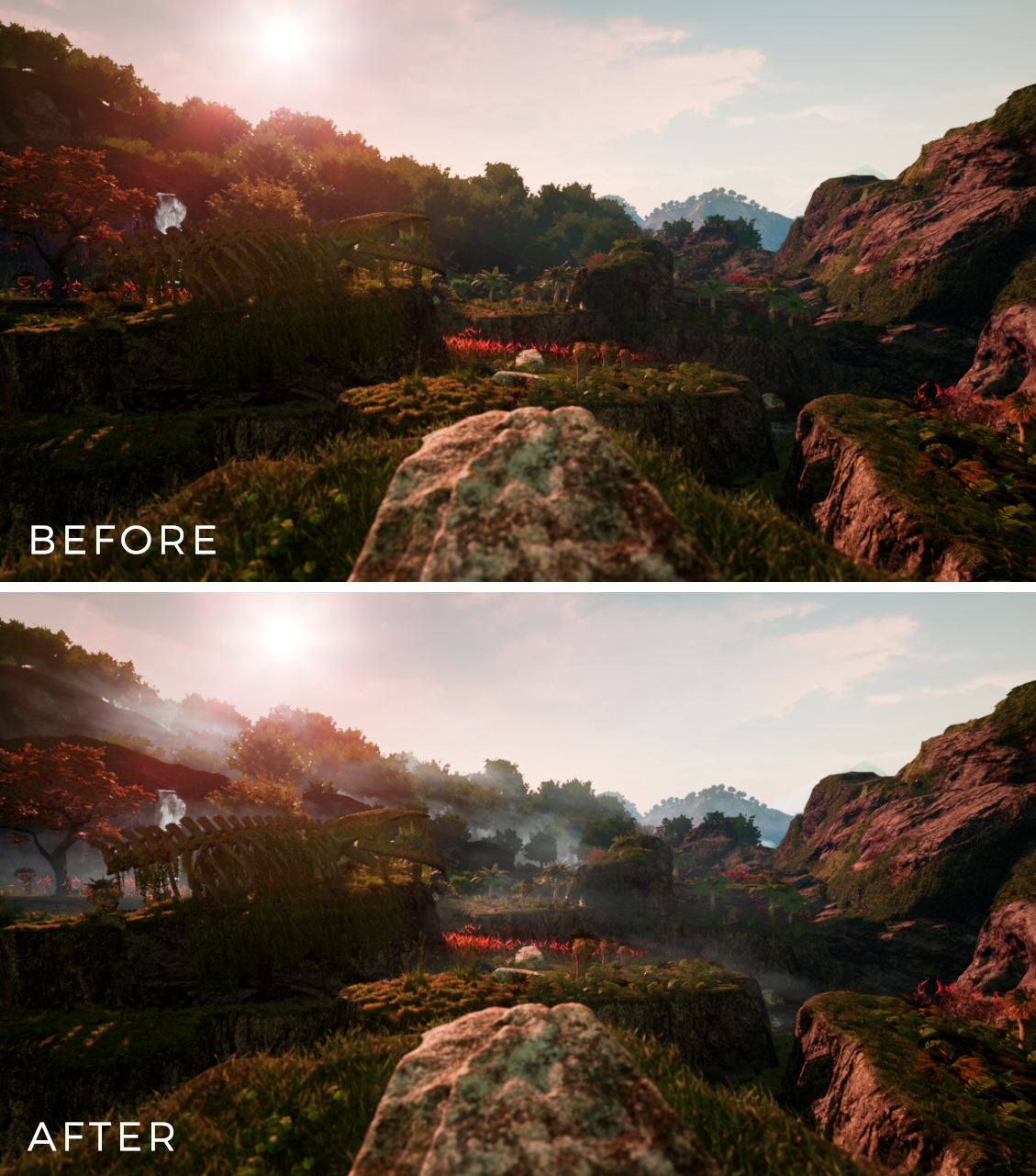
Fog helps us add a feeling of depth to the game; it separates ledges, highlights trees, and adds a sense of the unknown to a new landscape.
One way we achieved this effect is with volumetric fog, a technique that generates lots of particles where you want the fog to be and then calculates their density and how much light should shine through them at every point in that space. This creates the transparent, insubstantial look of fog, but also takes a lot of computing power. In order to maintain the atmosphere of AWAY on lower-performing hardware, we decided to turn to a more traditional method...
Instead of generating and performing calculations on a bunch of particles throughout the environment, we planned out where we wanted the fog to go and placed flat planes accordingly. These planes were then covered with a special fog material, which has both horizontal animation to capture the feeling of fog gliding across the ground and some noise to vary the transparency of the material. The result is the ethereal, flowing fog that exists in the game today (at much less computing cost than before!).
But the natural world isn't all sweeping vistas and scenic overlooks. There's real danger lurking in the wild...
Feeling Hot, Hot, Hot!
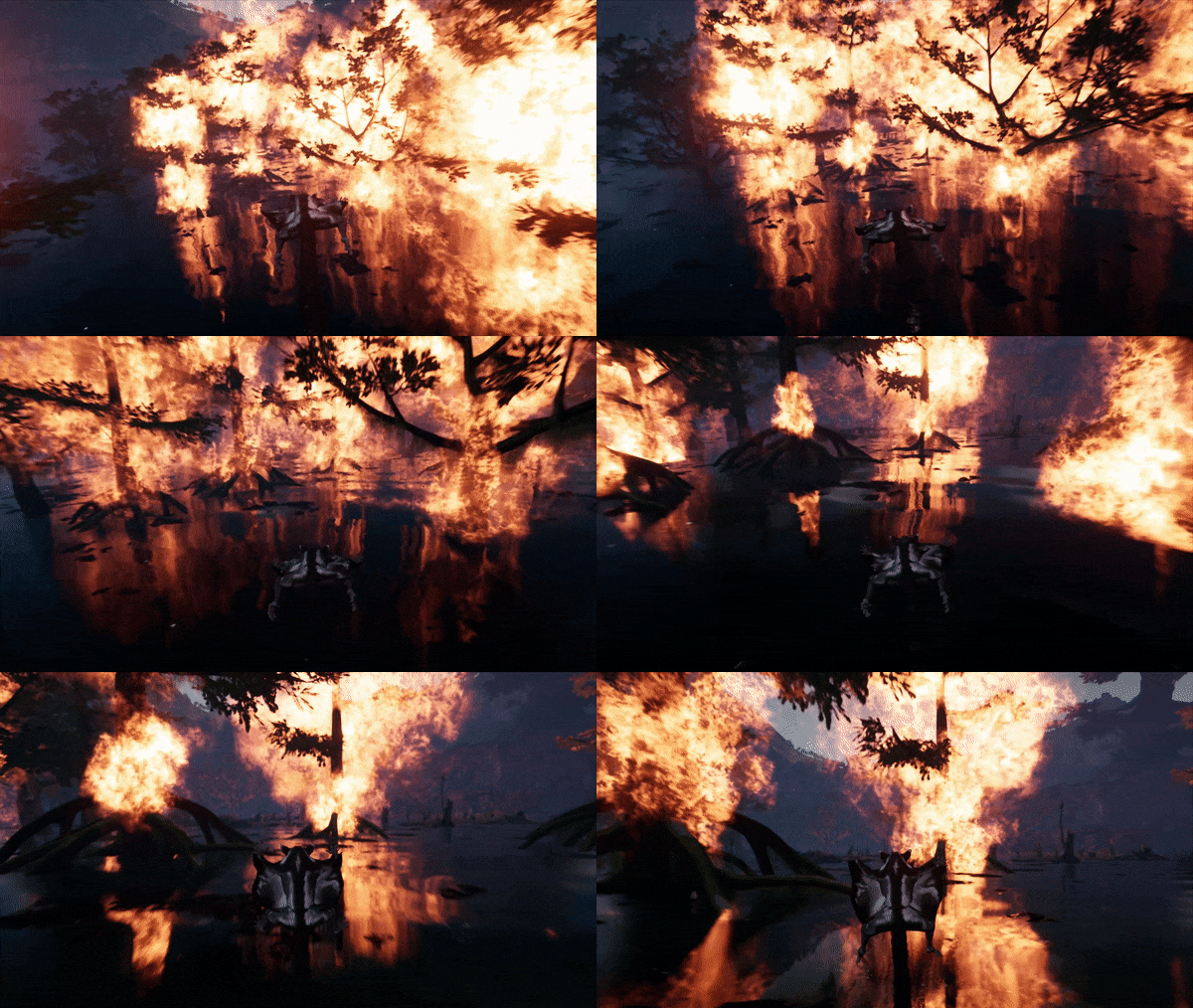
Designing natural disasters for AWAY is a unique challenge, and one of the most interesting ones to implement in-game is one you may have already seen: a sweeping forest fire. As you progress through the burning forest, the trees around you flicker and catch on fire until it seems like the entire world is burning around you. The secret behind this devastating blaze?
Big Orange Balls.
We give every tree that we want to catch on fire a transparent collision mesh, which shows up in the editor as an orange sphere. These collision meshes act as triggers for our fire; if one of the collision meshes overlaps with another, the corresponding tree will go up in flames.
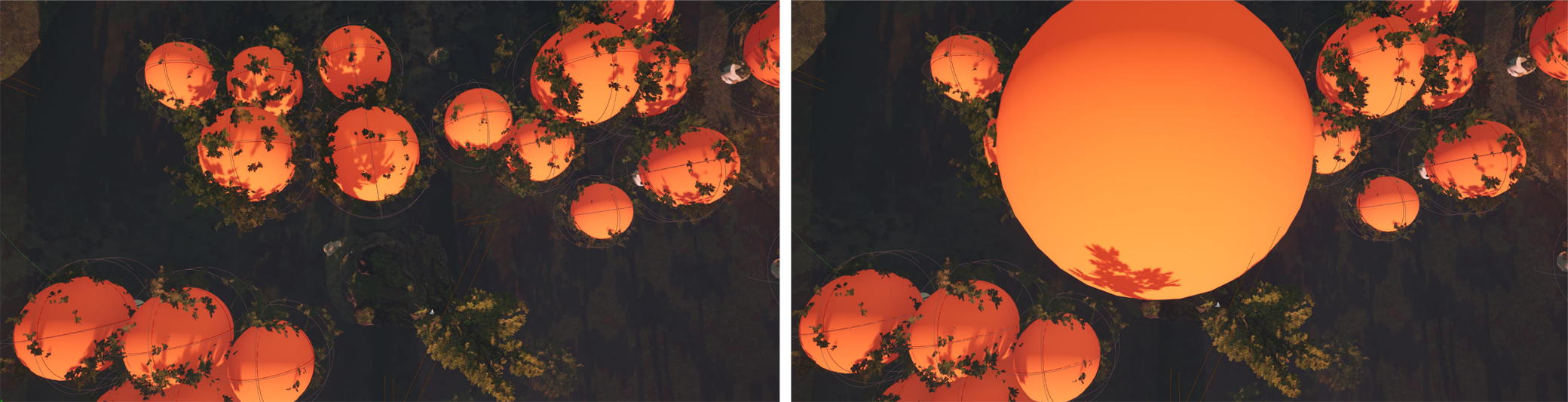
We also programmed each tree's mesh to grow larger the longer the tree is on fire, so over time the trees closest to it also begin to burn as the mesh expands and collides with the neighbouring meshes.
This system allows us to simulate the spread of fire through a forest, as well as letting us time the spread of the flames. All we need to do is set one tree on fire at the perfect moment, and our fire system handles the rest!
---
This sums up our first behind-the-scenes look at two systems we've implemented to make AWAY feel as immersive as possible (without melting any graphics cards!). Let us know if you found this interesting—we have plenty more behind the scenes content that we'd be happy to share with you if you like it!
~ the AWAY dev team